Thursday, June 20, 2013

Homework Blog 4

#1-3 p. 33

1. 


2. The mixture is heterogeneous because the molecules are not 
uniformly mixed. They are split between the top and bottom. 

3. Model of containers with the following samples of matter -

a. 

    b.

    c. 

    d. 

Wednesday, June 19, 2013

#9 for Blog Homework 3


Homework Blog 3


ISBS #1-12 p. 50

1. A physical property is a property that can be observed and measured without changing the chemical makeup of the substance.

2. Three physical properties of water are freezing point, density, and boiling point.

3. Solid water is less dense than liquid water.

4. When water is heated it turns to gas. When gas cools, it condenses and turns back into water. When water reaches its freezing point, it turns to ice.

5. A heterogeneous mixture is one that not uniform throughout, for example: foul water. A homogenous mixture is uniform, throughout, f0r example salt water.

6. When gasoline and water are poured into the same container and form two distinct layers, you need to know their densities in order to predict which liquid will be on top.

7. Solution, suspension, or colloid:

a. Medicine with instructions to "shake before use": suspension
b. Italian salad dressing: colloid
c. Mayonnaise: colloid
d. A cola soft drink: solution
e. Oil-based paint: suspension
f. Milk: colloid

8. Air would be a colloid because different air particles are spread throughout the room and the light will therefore go in all different directions.

10. The clear, red liquid would be a colloid because the light passes through the mixture, signifying tiny particles in the mixture that scatter the light.

11. The term substance means an element 1 or a compound 2 with a uniform composition, as well as very distinct properties. 

12. Element vs. compound:
a. CO: compound
b. Co: element
c. HCl: compound
d. Mg: element
e. NaHCO3: compound
f. NO: element
g. I2: element


Tuesday, June 18, 2013

Homework Blog 2


#2. I think that water shortage is worse because polluted water can be purified. However, not having enough water is unchangeable. Therefore, having polluted water is better than having a limited amount of water. And even though it might be hard to purify so much polluted water, it is better than nothing. 

ISAS #3, 4, 5, 6, 7 on p. 23
3.
a. Manufacture of the filter paper - is an indirect use of water because the trees that produced the paper had to be watered before
b. Pre-moistening of the sand and gravel - is the direct use of water because it is taken right from the sink and it's used to moisten the filter paper.
c. Use of water to cool the distillation apparatus - is direct because one may use water from the sink in order to change its forms 
4. Purifying water means to change any foul water to its most clean or natural form.
5. Three techniques that are used to purify water are oil-water separation, sand filtration, and charcoal adsorption and filtration.
6.  In sand filtration process, solid particles were removed. In charcoal adsorption and filtration, many unsanitary particles were removed from the water causing the water to turn clear. In the oil-water separation, oil was being removed.
7. The procedure used in the foul water laboratory investigation could not convert seawater into water that was suitable for drinking because salt particles are so small that they are unable to dissolve when mixed with water. Therefore, these steps are much harder to do for such a small particle. The way to make salt water suitable for drinking is by evaporating the water leaving only the salt and then having the steam bring back a purer form of water. 


A.8 #1-4 on p. 22

1. Three water uses that you could do without are washing tables, cars, and clothes. 
2. One activity that you could not do without is drinking water. 
3. You could reduce the use of water by taking shorter showers and by turning off the sink water while brushing your teeth and only turing it on when needed.
4. 
a. You could use impure water when washing your car, wiping windows, and washing floors. 
b. This water could be taken from the washing machine, washing your hands, or baths. 


Foul Water Lab Report

June 18th, summer of 2013
Dr. Forman
Julia, Kourosh, Clemmy (Hydrogen) 

Foul Water Experiment 

Abstract: 

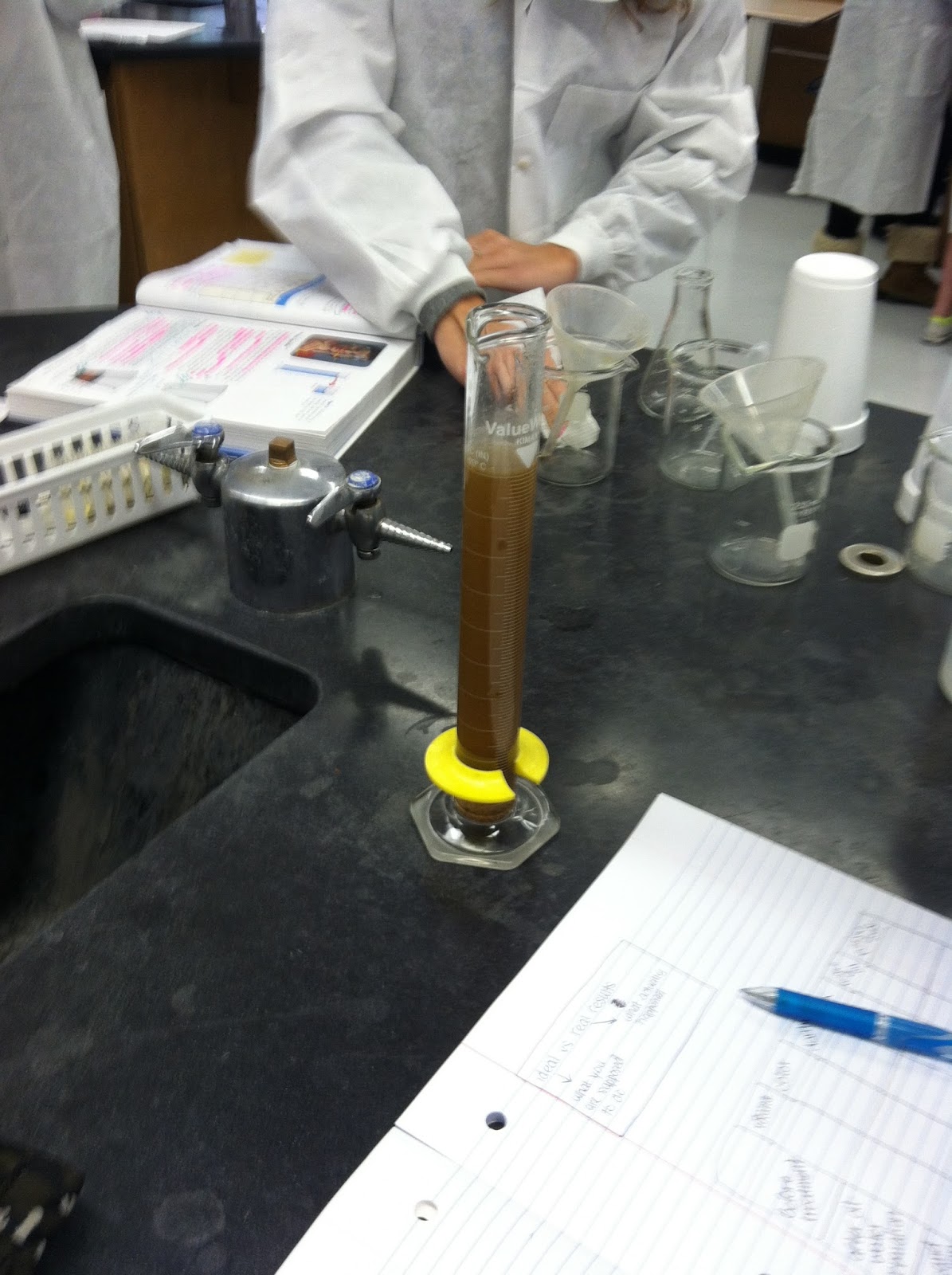
Durring our procedure we filtered foul water in 3 ways: oil water separation, sand flirtation, and charcoal adsorption and flirtation. Our group was able to purify the water successfully turing the brown water into clear water. Before we were not able to wash our hands in the water; however, at the end, we were able to. 

Procedure: 
  1. Make a data table
  2. Get 100 mL of foul water
  3. Fill out the first row of data in the table 
  4. Add oil to the water
  5. Allow your sample to sit for one minute causing the oil to rise to the top
  6. Remove the oil from the water
  7. Add distilled water to the removed oil
  8. Fill out the second row of data in the table 
  9. Dispose of the liquid 
  10. Poke holes in the bottom of a disposable cup 
  11. Add 1cm of gravel then 2 cm of sand and then another cm of gravel 
  12. Gently pour the sample into the cup
  13. Catch the filtrate in a beaker as it pours through
  14. Dispose of sand and gravel 
  15. Place a moist folded piece of paper into the funnel 
  16. Place the funnel into a clay triangle supported by a ring with a beaker underneath 
  17. Place 1 teaspoon of charcoal into the flask; pour the water, then stir 
  18. Gently pour the liquid through the paper allowing it to filter through
  19. If your filtrate is dark then repeat step 18 
  20. Then record your results

Results: 

Distillation: Salt water is heated in a test tube and the water evaporates, leaving only the salt. Then, the water vapor condenses and a pure liquid remains in the second test tube, while only salt remains in the first. 

Conductivity: When saltwater is placed under a conductivity test, the light bulb goes on. When distilled water is placed under a conductivity test, nothing happens. Therefore, even though both solutions "appear" to both be clear, they are actually different and have other minerals added. 


  1. Percent Recovery: 82%. 
  2. We lost 18 mL of foul water.
  3. We lost 18% of foul water.


Homework Blog 1

Blog Question 1: Water supply is essential for daily life; therefore, the lack of water is more critical in my opinion because by using the many different techniques that can purify water, the water pollution can then be cleansed. If there is not enough water to provide for the people, there is no way that can change, whereas water pollution is suitable for change.


ISAS #1, 2, 8-13, 17 on p. 23-24
1. He would have used more water if he drank just packaged fruit juice versus if he drank tap water. This is because after adding together the water inside of the container, the water used to make the container, and the water used to irrigate the fruit trees and process the fruit juice, the sum adds up to more water used than if he only drank tap water.
2. Three indirect uses of water associated with producing a loaf of bread are baking the bread, shipping the bread, and eating the bread.
8. Since water can be shown in many forms (solid, liquid, or gas), the total water has not changed in any amount of time.
9. Oceans, glaciers, water vapor, and rivers. 
10. In Riverwood, there is so much water everywhere that is killing all of the fish, but the people don’t know what the water is truly made of and so they cannot drink it.
11.   77% of water is used in irrigation and agriculture in the West. 
12.  a.     Glaciers and ice caps- 2.11% b.     Lakes- 0.0009%
13. When a dinosaur drinks water, it will over time evaporate because of water’s many forms. Then, later on, people can obtain the opportunity to then drink the same water molecule as that dinosaur.
17. 370 L of water is probably the direct water used, while 4960 L of water is probably the direct and indirect water used.


A.5 Water Use in the Economy
1.  a.     The East: steam and electric b.     The South: steam and electric c.     The Midwest: steam and electric d.     The West: irrigation and agricultural e.     Alaska: mining f.      Hawaii: irrigation and agricultural
2. In the East, there are more factories, so water is essential for those industries and is used mostly for steam and electric purposes. In the West, most people live on the farms, which are the majority of land, and water is used mostly for irrigation and agricultural purposes.
3.               a.     The East

In the East, the industries and seasonal changes are two factors that could explain the greatest water use (steam and electric) within the region.
b.     The South
In the South, the industries and seasonal changes are two factors that could explain the greatest water use (steam and electric) within the region.
c.     The Midwest
In the Midwest, the factories and seasonal changes are two factors that could explain the greatest water use (steam and electric) within the region.
d.     The West
In the West, there are many farms and the moderate temperatures could explain the greatest water use (irrigation and agricultural) within the region.
e.     Alaska
In Alaska, the cold weather and industrial economy could explain the greatest water use (mining) within the region.
f.      Hawaii
In Hawaii, the plentiful lands and reasonable climates could explain the greatest water use (irrigation and agricultural) within the region.